It never stopped on one date; it faded. In the 1930s perhaps three-quarters of U.S. milk was delivered to the door, and in 1954 still 54 percent. The share fell below half in 1957 and to 19 percent in 1971. In the federal milk-order markets that USDA surveys in November, home delivery was 6.9 percent of milk sold in 1975, 1.5 percent in 1985 and 0.2 percent in 2023.
The milkman’s share fell every year from 1954 to 1971, by the U.S. Department of Agriculture’s estimate.
| Year | Fluid milk delivered to homes |
|---|---|
| 1954 | 54.0% |
| 1956 | 50.4% |
| 1957 | 48.5% |
| 1960 | 43.8% |
| 1963 | 37.0% |
| 1971 | 19.3% |
Those are the USDA’s yearly estimates for all the fluid milk sold in the country. After 1971 the trail picks up in a different count, a USDA survey of the federal milk-order markets taken in November. There home delivery was 6.9 percent of milk sold in 1975 and 1.5 percent in 1985. The two counts don’t measure the same milk, and for 1963 the November survey found 29.7 percent against the table’s 37.0. That lower number is the “about 30 percent in 1963” you’ll often see quoted.
How the milk got to the door
The first milkmen carried cans. At each stop, usually the wife of the house brought a pitcher or a pail out to the wagon, and the milkman ladled out what she wanted. “Loose milk” was still sold that way in New York City in 1922, when the state tuberculosis association blamed it for spreading the disease.
A Potsdam, N.Y., man named Thatcher (Harvey in one history, Hervey at the local museum) offered bottles embossed “Thatcher Milk Protector” in the 1880s, with ads promising “ABSOLUTELY PURE MILK.” The Potsdam Public Museum still has his mold, and its archivist, Hans Kuno, explains why he bothered: before bottles, “the hair from the horse and the dirt from the road would go in the milk.” The Common Sense bottle, patented on Sept. 17, 1889, with a cardboard disk pressed into its neck, became the industry standard by 1900, and by 1902 Thatcher’s bottles came with “TO BE WASHED AND RETURNED” on the back.
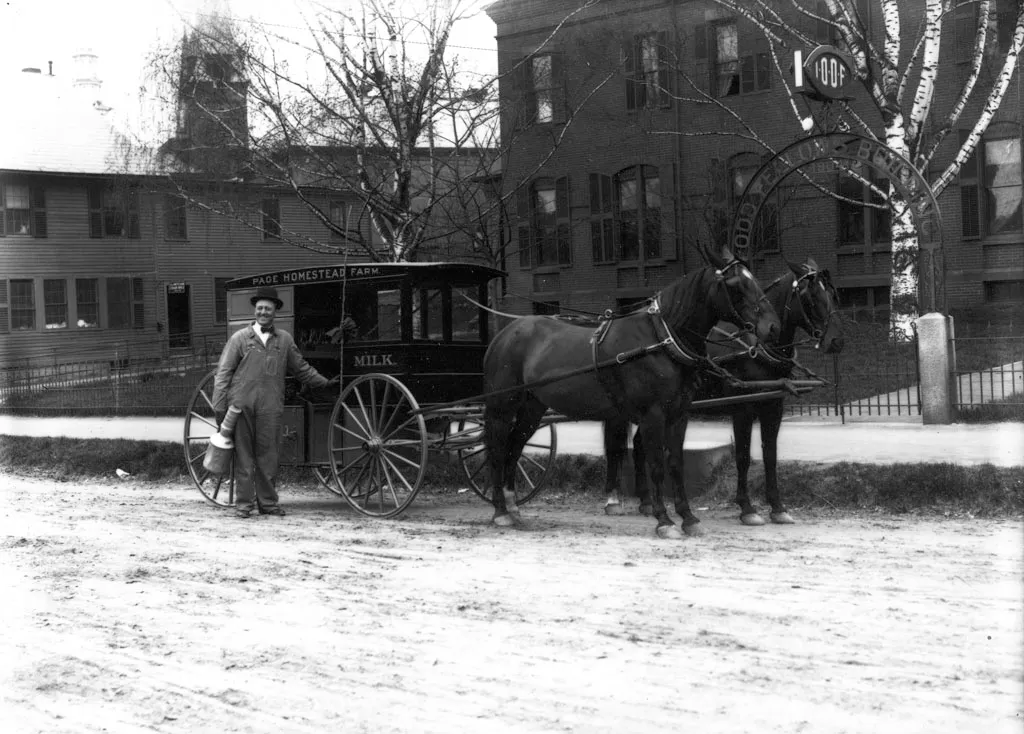
A Page Homestead Farm milk wagon on Roxbury Street in Keene, N.H. Photo by Bion Whitehouse, courtesy of the Keene Public Library and the Historical Society of Cheshire County, no known restrictions, via Wikimedia Commons.
The empties went back in a box on the porch. Thatcher’s 1887 plan already had a box big enough for six quarts and a “Patrons’ Want Scale” to set the next day’s order. Some houses had a milk chute that slid the bottles inside, and later came insulated aluminum boxes by the front door for milk left in the early morning. A 1941 patent turned the order into a cardboard dial stuck in the neck of an empty bottle, with tabs like “1 Qt. Milk EXTRA.”
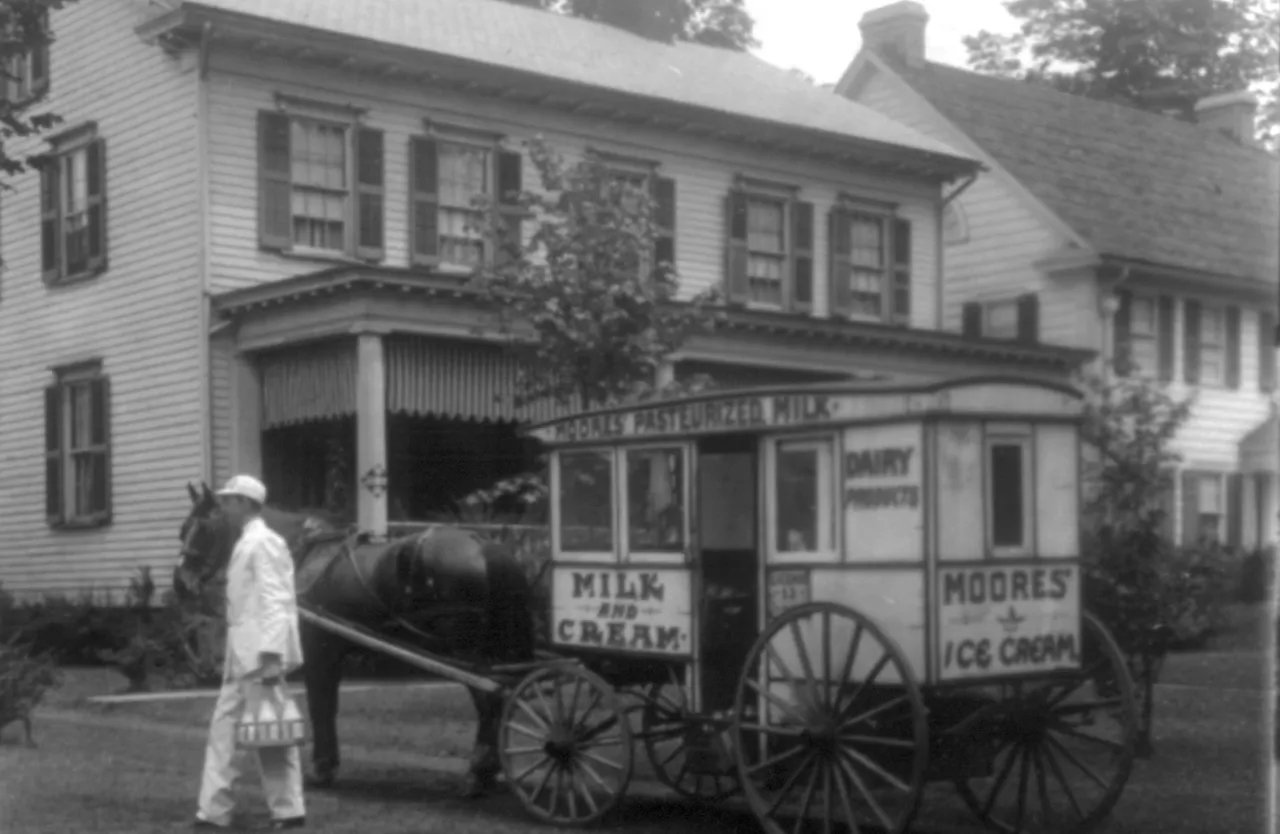
Guernsey Le Pelley, writing in The Christian Science Monitor in 1987, remembered milkmen as “the last to give up horses for delivery,” because the horse knew the stops. The Hygienic Dairy in Watertown, N.Y., retired its last horse-drawn wagon on April 30, 1937. Trucks were already on the routes by then. Divco built its multi-stop delivery trucks from 1926 until 1986, and the Divco Club’s line is “Chances are your milkman drove a DIVCO.”
What the milkman’s quart cost
Delivered milk usually cost a little more than store milk, and from the 1950s the gap widened. In 1941 a delivered quart in Chicago cost 14 cents, against 12 cents in a store; in New York it was 15 against 14. The national averages from the Bureau of Labor Statistics:
| Year | Delivered | At the store | Extra per quart |
|---|---|---|---|
| 1955, quart | 23.1¢ | 21.9¢ | 1.2¢ |
| 1960, quart | 26.0¢ | 24.7¢ | 1.3¢ |
| 1964, half gallon | 52.8¢ | 47.7¢ | 2.6¢ |
| 1967, half gallon | 57.4¢ | 51.7¢ | 2.9¢ |
For the half-gallon rows the extra per quart is the gap divided by two.
Through the late 1950s the extra on a quart hardly moved, and it was 1.2 cents in 1959 just as in 1955. By 1964, priced in half gallons, the milkman’s extra per quart was about double what it had been for quarts in 1960.
That 1960 delivered quart is about $2.96 in today’s money. Count four quarts as a gallon and 1960 milk comes to about $11.26 at the store and $11.85 delivered, against $4.11 for a gallon jug of whole milk in September 2026. That sets single quarts against a jug, so it isn’t an exact match. Allowing for that, a gallon’s worth of milk cost roughly two and a half to nearly three times what it costs now, delivered or not, and “milk was cheap back then” gets it backwards.
Milk was getting easier to afford, though. In September 1960 a factory worker earned a store-bought quart in about six minutes of work, two minutes less than in 1953.
Why the milkman disappeared
The move to stores began before the war. A 1942 Farm Credit Administration report called the drop in milk sold from home-delivery routes “the foremost change of recent years” in how milk was distributed. In Chicago, stores went from selling less than a quarter of the milk in the early 1930s to nearly half by 1941, and in New York from 30 to 50 percent between 1930 and 1941. Paper cartons, introduced in New York in 1937, appear to have given store sales “a second stimulus,” the report said. Safeway’s Lucerne dairy began using Pure-Pak cartons the next year.
Glass stayed with the milkman. A 1965 USDA survey found it, though in the minority, “prominent at the home-delivered level.” In the federal-order markets glass held 29 percent of the milk sold that November and about 2 percent ten years later, as the routes shrank.
State boards that fixed milk prices often wouldn’t let stores sell for less than the milkman. In a number of cities the milk wagon drivers’ unions resisted the shift to stores too, to keep the jobs their members counted on. Under union contracts in the 1940s, those drivers were usually paid a minimum weekly guarantee plus a commission on what they sold, the Bureau of Labor Statistics found, and the agreements commonly classed them as salesmen.
World War II cut how often the milk came. To save trucks, gasoline, rubber and men, the Office of Defense Transportation banned daily delivery, according to a 1966 West Virginia University study. After the war many dairies stayed with every other day, later it was three days a week.
Looking back from 1973, the USDA gave three reasons for the fall after 1954: milk was easier to get at stores, the price gap between delivered and store milk kept widening, and more milk was drunk away from home.
Of those three reasons, the price gap is the one we can check against what customers themselves said. In 1961 West Virginia University researchers asked delivery customers in Ashland, Ky., and Wheeling, W.Va., how many cents a quart above the store price they would pay to keep having milk brought to the house. Six in ten said 2 cents or less, and fewer than one in five would go past 3 cents.
In Ashland the milkman was already charging that much. In 1959 delivered milk there cost 2 cents a quart more than store milk, and in half gallons 3 cents a quart more. So the extra had reached about what most of his own customers thought the service was worth, and those were the people still buying from him; the ones who had gone over to the store weren’t asked. Nationally the gap kept growing after that. The researchers themselves thought the price differences didn’t change much what their customers bought, which is a fair warning that cents alone don’t tell the whole story.
Who still delivers
In the USDA’s November surveys home delivery is now a sliver. The Upper Midwest had the most among the markets with published figures, 3 percent in 2021 and 1.2 percent in 2023. From 2015 on the USDA has counted delivery a little differently, so these recent years may not line up exactly with the older ones.
A handful of dairies never stopped. Crescent Ridge Dairy in Sharon, Mass., started in 1932 with a 1928 Chevrolet milk truck and half-pint glass bottles, and says its milkmen still make their rounds every week. By 1990, when home delivery was about 1 percent of U.S. milk sales, it had some 12,000 customers. One of its milkmen, Frank Coffey, told The Christian Science Monitor that year, “Years ago, we’d go right into the kitchen and put it in the refrigerator; we knew the whole family.”
Questions people ask
What was the milk box on the porch for?
The milkman left the bottles in it and picked up the empties. Patents from 1926 and 1932 promised boxes that kept milk cold in summer and kept it from freezing in winter, and from the 1940s a cardboard dial in an empty bottle told the milkman what extra to leave.
Why did old milk bottles have a bulge at the top?
Those were cream-top bottles, patented in 1925. The cream rose into the bulb in the neck so it could be poured off. Homogenized milk, where the cream doesn’t separate, made them pointless.
Do milkmen still exist?
A few. Some local dairies still deliver, among them Crescent Ridge Dairy in Sharon, Mass., which has delivered since 1932. In the USDA’s 2023 survey home delivery was 0.2 percent of milk sold in the markets it covers, and the Upper Midwest had 1.2 percent, the highest among the markets with published figures.
Written by Wance Payton, Oct. 27, 2026
19 sourcesWhere these facts come from
- Alden C. Manchester, Sales of Fluid Milk Products, 1954–72, USDA ERS
- USDA AMS, Packaged Fluid Milk Sales in Federal Milk Order Markets, November 2023
- USDA AMS, Packaged Fluid Milk Sales in Federal Milk Order Markets, November 2021
- USDA AMS, Packaged Fluid Milk Sales in Federal Milk Order Markets, 1963 to 2007
- USDA, Packaged Fluid Milk Sales in Federal Milk Order Markets, November 1965
- Herrmann and Welden, Pre-War Developments in Milk Distribution, Farm Credit Administration, 1942
- BLS Bulletin 1217, Retail Prices of Food 1955–56
- BLS Bulletin 1301, Retail Prices of Food 1959–60
- BLS Bulletin 1632, Retail Prices of Food 1964–68
- BLS Bulletin 732, Wages and Hours of Union Motortruck Drivers and Helpers, June 1, 1942
- BLS Bulletin 874, Union Wages and Hours of Motortruck Drivers and Helpers, 1946
- Clarke, Haught and Shaw, Twice-Weekly Milk Delivery, West Virginia University, 1966
- Bill Lockhart, "Dating Milk Bottles," Society for Historical Archaeology
- Bill Lockhart, "Dating Other Milk Containers and Accessories," Society for Historical Archaeology
- WWNY, "History Lesson: Dr. Hervey Thatcher's glass milk bottle," July 12, 2024
- Guernsey Le Pelley, "Milkmen of yesteryear," The Christian Science Monitor, Oct. 6, 1987
- Kirsten A. Conover, "Milkmen Deliver Nostalgia," The Christian Science Monitor, May 2, 1990
- North Country at Work, Hygienic Dairy Company delivery wagon, Watertown, N.Y.
- Crescent Ridge Dairy, "Our History"