Hide-and-seek needs a tree or lamp-post for home base, and Kick the Can adds a can. Hopscotch takes a figure drawn on the ground and a flat stone, jacks 10 jacks and a small rubber ball, jump rope a rope, or two for Double Dutch. Tag, Red Rover, Red Light, Statues, Mother May I and Duck, Duck, Goose need only a few kids. Most were in print by 1909 (Red Light as Step), and all by 1953.
In 1891 a 10-year-old boy in Brooklyn described the games he played in the street to Stewart Culin, who printed them in the Journal of American Folk-Lore. Kick the Can is there, though as a different game from the hiding one most of us played. So are Red Rover and hide-and-seek, which Culin filed under I spy. In the city, Culin wrote, “paved streets and iron lamp-posts and telegraph poles take the place of the village common.”
The other rules were printed or recorded between William Wells Newell’s 1883 book and a Library of Congress tape made in a Virginia schoolroom in 1978. Many are marked by the state they came from, and some of those were written by college freshmen. Starting in 1939, Paul Brewster had his composition students at the University of Missouri each write up a game they’d played in grade school. He kept collecting into the early 1950s, and his book, American Nonsinging Games, came out in 1953.
Hide-and-seek and its old calls
One player is It. He hides his eyes at home base, usually a tree or a lamp-post, and counts out loud while everybody else hides. Newell’s children counted to a hundred. The Brooklyn boy counted to 500 by fives, shouting out each hundred, and then gave fair warning: “One, two, three! / Look out for me, / For my eyes are open, / And I can see!”
Brewster’s Nebraska version gives the seeker’s calls in order, which is handy if you’re teaching it. First comes “All not hid, holler ‘I’!” If nobody yells, it’s “A bushel of wheat and a bushel of clover; all not hid can’t hide over!” Last is “All eyes open; here I come!”
Then he hunts. A hider who’s spotted races him back to base, and whoever gets there first and shouts “One, two, three for me!” or just “Home free!” is safe. Once the seeker has caught somebody to be It next, he can call “All the rest home free,” and everyone still out comes in.
The hiders had their tricks. In Brooklyn, where home base was “hunk,” two boys would swap hats so the seeker called the wrong name, then both cried “False alarm!” and came in free. Seekers had one too, a quick count that Newell says was “not accounted fair”: “Ten, ten, and double ten, / Forty-five and fifteen.”
“Olly olly oxen free” is the same kind of all-clear. It probably started as something like “all in free” or “all’s out come in free,” with “all-ee” heard as the name Ollie, and it came in dozens of forms. On the radio show A Way with Words, one of the hosts read out a Utah form from a dictionary of regional speech, “Olly Olly Oxford all in free.” A caller said her grandmother, who was from Austin, Texas, remembered it as “all the outs in free.”
Kick the Can
The seeker starts the game with a kick. He sends the can as far as he can, and while he goes after it, everyone else scatters and hides. From then on, the Arkansas rules in Brewster’s book say, “the game is played like Hide and Seek.”
Prisoners are freed the way they are in the stick games. In an Illinois version played with a broomstick, the seeker leans it against a tree or a lamp-post, and a hider who can slip out, seize it and throw it away lets every captured player run off and hide again. A 1940 game book, The Fun Encyclopedia, calls Kick the Can “the same game as ‘Throw the Club,’ except that a can is used. Players kick the can instead of throwing the stick.” So the rescuer kicks the can away, and the seeker has to go after it again.
Phyllis McGinley looked back on those games in Good Housekeeping in 1951, in an essay called “When Kids Played Run, Sheep, Run.” She remembered the vacant lots where she’d played as “our stamping grounds,” and Kick the Can as “something deliriously active.”
The 1891 Kick the Can
The Brooklyn boy’s game was a base-running one, with a lamp-post or a tree for home and usually four bases to run around. The can, “usually a tomato can, mounted on a rock,” took the place of the “wicket” in a game called Kick the Wicket. The wicket could be a piece of wood or “a piece of old rubber hose.” His hiding game with a stick was Throw the Stick. One boy threw it as far as he could, and It had to fetch it and put it back while the rest hid.
The freeze games: Red Light, Mother May I and Statues
Each of these asks players to stop dead. In Steps and Statues, Brewster wrote, players “must be prepared to ‘freeze’ instantly at a second’s notice,” which is “not an easy thing for youngsters to do, but they appear to enjoy trying it.”
Red Light
The counter stands on a line with his back to the others, who start some way off. He counts out loud while they move toward him, then calls “Red Light!” At that word everyone has to freeze, and he turns around to look. Anyone he catches moving goes back, either to the starting line or a set number of steps agreed on before the game. The first player to reach the goal wins.
Brewster’s Mississippi version has It count “rapidly to ten.” Jessie Bancroft’s 1909 game book has it as Step, where the counter stops at “Ten!” and turns. She found it “a great favorite, especially with girls, though the writer has known many boys to play it persistently.” McGinley had a third name for it: “Cheeseit is now called Red Light.”
Mother May I
The leader stands facing the others, some distance away. A player calls out, “How many and what kind?” and the leader answers with something like “Three baby ones” or “Two giant ones.” Then the whole line takes just those steps. The first one to reach the leader and touch her leads the next game. Those rules are from a Georgia version, where the game was simply called Steps.
McGinley was told by “the experts” that Giant Steps was “a variation of old-fashioned May I?” You take so many Giant Steps, Baby Steps or Scissors Steps “before you freeze in your tracks.” The old books give the steps and the freeze, but not the asking of “Mother, may I?” before a move.
Bancroft’s 1909 “Mother, May I Go Out to Play?” is a different game, an acted-out talk between mother and child. When the child points out that the sun is shining, the mother says, “Well, make three round courtesies and be off away.”
Statues
The leader takes one player by the hand, whirls around with her and suddenly lets go. The player has to freeze exactly as she ends up. Once everybody has had their spin, the leader picks whoever was left in “the most ludicrous attitude” to lead next. That one is from Oklahoma.
An earlier write-up, in the Atlanta Constitution in 1901, plays it differently. A “sculptor,” picked with “eeny, meeny, mina, mo,” lines up her playmates and calls out the feelings she wants them to show, such as “sad,” “glad,” “mean” and “kissing.”
Red Rover
Two teams stand on lines some distance apart, facing each other, with hands clasped. One side calls, “Red Rover, Red Rover, let ___ come over!” The player named runs at the other line and tries to break through the clasped hands. Break through and you go back to your own side, fail and you stay with them. That’s the Montana version, and Bancroft’s 1909 book has the same line-breaking idea as Forcing the City Gates, which she calls a Chinese game.
The Brooklyn Red Rover of 1891 had one catcher. He stood in the middle of the street while the others lined the pavement. When he called a boy by name, that boy had to run for the opposite sidewalk, and if he got caught, he joined the Red Rover and helped catch the rest. Each time the catcher grabbed someone, he had to cry “Red Rover” three times, “or he cannot hold his captive.” Ten years later the Atlanta Constitution piece still printed the call as “Red Rover, Red Rover! Some one come over!” with It standing in the street.
Duck, Duck, Goose (and gray duck, in Minnesota)
One child goes around tapping the others on the head, saying “Duck, Duck, Goose.” The one tapped on “Goose” jumps up and chases the tapper, and has to catch her “before she reaches her seat.” A child who’s caught stands aside and later does “some stunt by way of forfeit.” Springfield, Ill., put the game in its 1922 course of study for the primary grades, played right at the desks with everyone’s eyes closed.
Minnesota plays it as Duck, Duck, Gray Duck, a name the radio show A Way with Words calls “associated almost exclusively with Minnesota.” Nobody has settled where the gray duck came from. Some Minnesotans, the hosts say, trace it to a Swedish game. The hosts lean toward a kindergarten textbook first published in 1936 by two women at the University of Minnesota, Josephine Foster and Neith Headley. Its 1948 edition explains the gray duck game, and in that version the caught child goes to the middle of the circle, “squatting like a duck.”
Ring Around the Rosie
The children make a ring around one child in the center, who “represents the ‘rosie.’” They go around singing, and at the end of the words everybody stoops down fast. The last one down pays a penalty or takes the place of the child in the middle.
Newell’s main text, from New Bedford, Mass., goes “Ring a ring a rosie, / A bottle full of posie, / All the girls in our town, / Ring for little Josie.” A plainer one he lists ends “One, two, three—squat!” None of his versions has ashes, and nobody falls down.
Children were still singing it in 1939. That year a group of African American schoolgirls in East Texas sang their version for John and Ruby Lomax, who recorded it for the Library of Congress.
The plague story is a much later idea. Stephen Winick, a folklorist at the Library of Congress, traced the first direct reference to it in print to 1951.
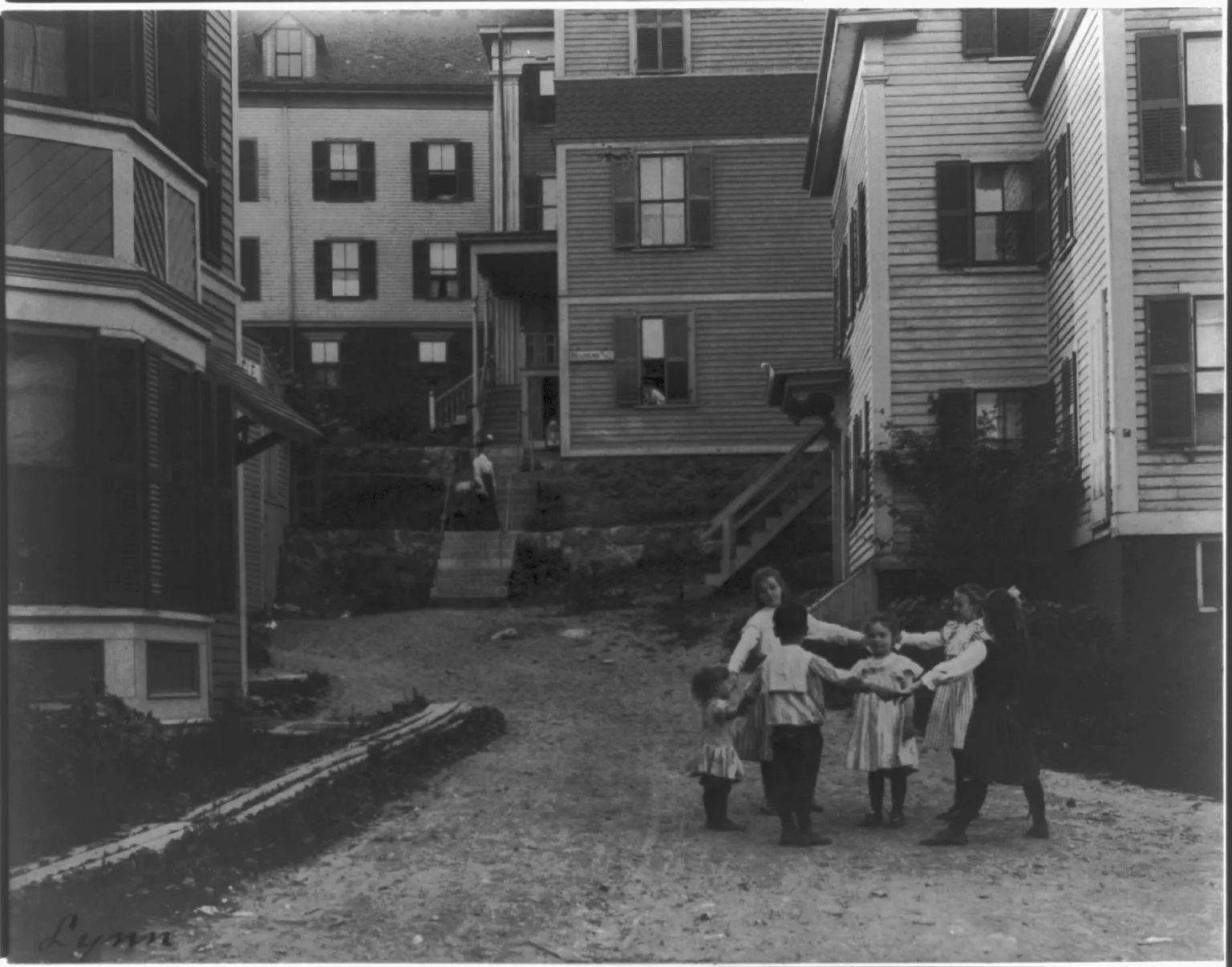
Children playing “ring around the rosie” between workers’ houses in Lynn, Mass., about 1895. Library of Congress, public domain, via Wikimedia Commons.
Tag and Ring-a-lievio
Tag had its variations early. In squat tag “the fugitive is safe while in that position,” and Newell called Iron Tag, or Tag on Iron, “once universal in the United States.” In 1931 a Columbia University researcher asked 10,000 fourth graders, from Springfield, Mass., to Houston, about their games. Tag came out as the favorite playground game, named by 3,444 of them.
Ring-a-lievio, as Bancroft gives it, is, if anything, rougher. Mark out a den about 5 feet square. A catcher can’t just tag a runner, since “tagging is not enough; the player must be firmly secured,” and once he has hold of one he calls “Caught! Caught! Caught!” A rescuer can free one prisoner at a time by dashing into the den, tagging him and shouting “Ring-a-lievio!”
Boys playing Stealing Hats chose sides and lined their hats up on the curb. The 1901 newspaper piece that describes it added that “it is hard on the hats, as mothers will testify.”
Hopscotch, jacks and marbles
For hopscotch you need a figure drawn on the ground, about 12 feet long. And a small flat stone, one “having sharp edges.” You hop through the figure, and touching down the raised foot or stepping on a line puts you out. Those are Newell’s rules, and in New York the last box was called Pot.
The Brooklyn boy drew his diagram across five sidewalk flagstones. Boys and girls both played “Kick the stone out,” and “Pick the stone up” was said to be for girls only.
Jacks takes 10 jacks and a small rubber ball. Toss the ball and pick up one jack while it’s in the air, then two, and so on. You keep going until you can grab all 10 at once “while the ball is still in the air.” The jacks were once pebbles. By Newell’s day “little double tripods of iron” had taken their place, and the fifth stone, the “jack,” was often a ball or a marble. Its tricks had names like “Horses in the Stall,” “Set the Table” and “Jumping the Ditch.”
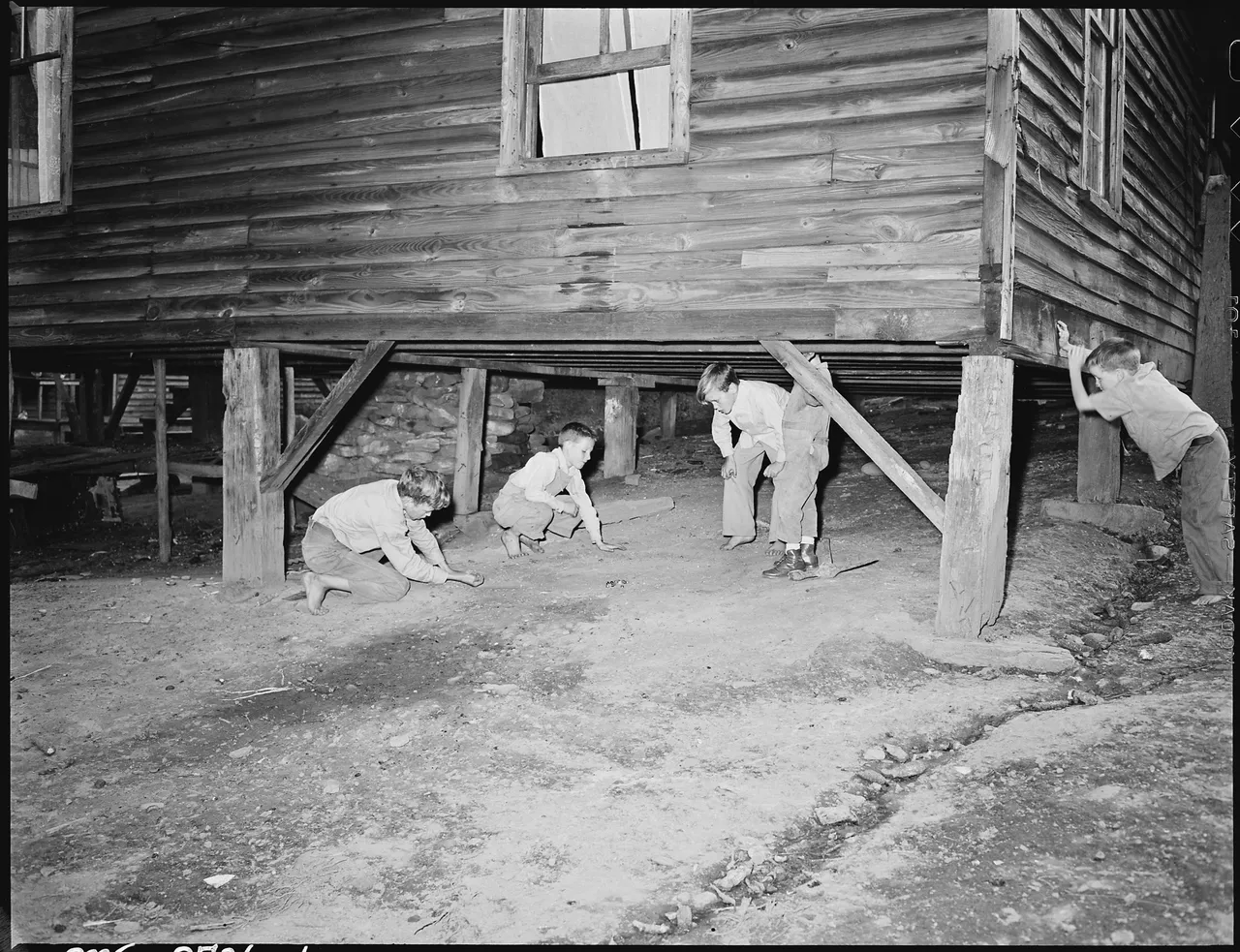
Marbles came in glass, clay or agate, and agates were the favorite shooters, though some kids shot with “steelies,” small ball bearings. The boys Newell quoted “never used the word marbles, but mibs,” as in “Let’s play mibs.” Playing to win the other fellow’s marbles was playing “in earnest,” and the call was “Knuckle down tight where you lay!”
Jump rope rhymes
Two turners swing the rope and say the rhyme, and the jumper does what it tells her or keeps going until she misses. The teddy bear rhyme tells the jumper what to do: “Teddy bear, teddy bear / Turn around / Teddy bear, teddy bear / Touch the ground,” then on through show your shoe, say your prayers, go upstairs and turn out the light. It’s on a 1955 Folkways record of skip-rope games that Pete Seeger recorded in Edgewood, Ill.
Some rhymes count. “Cinderella, dressed in yellow / Went upstairs to kiss her fellow / How many kisses did she give him?” and then the numbers, as long as the jumper lasts. “Apples, peaches, creamery butter / Tell me the initials of your true lover” runs through the alphabet until she misses.
Others speed up. In Bancroft’s book the turners say “Salt, pepper, mustard, cider, vinegar,” turning faster on “vinegar.” The Folkways notes call that kind of very fast turning peppers, perhaps the best-known term in all of skip rope. With two ropes, Brewster’s Indiana jumpers turned them inward for Double Dutch and outward for Double Irish. When there wasn’t a rope to be had they made do with “a length of grapevine.”
Skip rope was popular “particularly among girls,” the Folkways notes say. On Sept. 12, 1978, the folklorist Patrick Mullen recorded fourth graders in Ararat, Va., for the Library of Congress. The first item on the tape was “Cinderella Dressed in Yella,” and the boys dropped out when jump rope rhymes came up.
McGinley heard two little girls “furiously whirling the rope” in her back yard to “Strawberry—shortcake, cream on tart. Tell me the name of your sweetheart.” Down the street, other children bounced balls to “Teddy bear, Teddy bear, touch your dirty shoe. Teddy bear, Teddy bear, twenty-three, skiddoo!”
Do kids still play outside like that?
Less than their mothers did, if a 2004 survey is any guide. Rhonda Clements of Hofstra University asked 830 mothers across the country how they played as children and how their own children played. Most of the mothers were between 25 and 44, so they grew up mostly in the 1960s, ’70s and ’80s.
| The mothers, as children | Their children | |
|---|---|---|
| Played outdoors every day | 70% | 31% |
| Stayed out three hours or more at a time, when they played outside | 56% | 22% |
| Played jump rope, hopscotch and street games with kids’ own rules | 85% | 33% |
| Often played chasing games like tag | 93% | 64% |
Most of the mothers put television and computer games first among the reasons, and nearly as many named worries about crime and safety.
McGinley was already writing about it in 1951. “There are no barns any more, even in our village,” she wrote. “There are only garages, and most of them attached to houses.” Vacant lots were scarce or posted “No Trespassing,” and games like Red Rover had moved to “schoolyards at recess,” or to a gym “under supervision.” “Listen carefully,” she told her readers, “and you can still hear the great dare of ‘Red Rover, Red Rover, let David (or Nancy or Kevin) come over.’”
Questions people ask
What does “olly olly oxen free” mean?
Nobody knows for sure. The best guess is that it started as something like “all in free” or “all’s out come in free,” the call that lets hiders come back to base, and that “all-ee” was heard as the name Ollie. It turns up in dozens of forms across North America, and children’s sayings were hardly written down before the 1950s.
Is Ring Around the Rosie about the plague?
The plague story came late. The American versions William Wells Newell printed in 1883 have no ashes and nobody falls down; one ends “One, two, three—squat!” A Library of Congress folklorist traced the first direct reference to the plague reading in print to 1951.
What’s the difference between Mother May I and Red Light, Green Light?
In Red Light the players move while the counter has his back turned and must freeze when he calls “Red Light!” and turns around; anyone caught moving is sent back, and the first to reach the goal wins. In Mother May I, which Georgia children called Steps, the leader tells the players how many steps to take and what kind, such as “three baby ones” or “two giant ones,” and the first to reach the leader leads the next game.
Why do Minnesotans say “Duck, duck, gray duck”?
No one has settled it. Some Minnesotans say it came from a Swedish game. Another theory points to a kindergarten textbook by two University of Minnesota educators, first published in 1936, whose 1948 edition describes the gray duck game.
Written by Wance Payton, Oct. 24, 2026
17 sourcesWhere these facts come from
- William Wells Newell, Games and Songs of American Children, Harper & Brothers, New York, 1883
- Stewart Culin, "Street Games of Boys in Brooklyn, N. Y.," Journal of American Folk-Lore, vol. 4, July 1891
- The Atlanta Constitution, "Popular Street Games Have Greatly Changed," Dec. 1, 1901
- Jessie H. Bancroft, Games for the Playground, Home, School and Gymnasium, Macmillan, New York, 1909
- Springfield Board of Education, Springfield, Illinois, Course of Study for the Primary Grades, 1922
- Norma Schwendener, Game Preferences of 10,000 Fourth Grade Children, Columbia University, 1932
- E. O. Harbin, The Fun Encyclopedia, 1940
- Phyllis McGinley, "When Kids Played Run, Sheep, Run," Good Housekeeping, condensed in The Catholic Digest, June 1951
- Paul G. Brewster, American Nonsinging Games, University of Oklahoma Press, 1953
- Skip Rope Games, recorded in Edgewood, Illinois, by Pete Seeger, notes by Esther Brown, Folkways Records FP 729, 1955
- Stephanie Hall, "Kids Explain Their Rhymes, Games, and Songs," Folklife Today, Library of Congress, June 5, 2020
- Stephen Winick, "Ring Around the Rosie: Metafolklore, Rhyme and Reason," Folklife Today, Library of Congress, July 24, 2014
- Jesse Sheidlower, Random House word of the day on "olly olly oxen free," April 22, 1997
- Michael Quinion, "Olly olly oxen free," World Wide Words, Oct. 23, 1999
- A Way with Words, "'Ollie, Ollie Oxen Free' and Other Hide-and-Seek Calls," Feb. 9, 2008
- A Way with Words, "In Minnesota, It's Duck, Duck, Gray Duck," Jan. 30, 2023
- FOX 9, "St. Paul Saints to settle 'duck, duck, goose' versus 'duck, duck, gray duck' debate once and for all," April 18, 2017