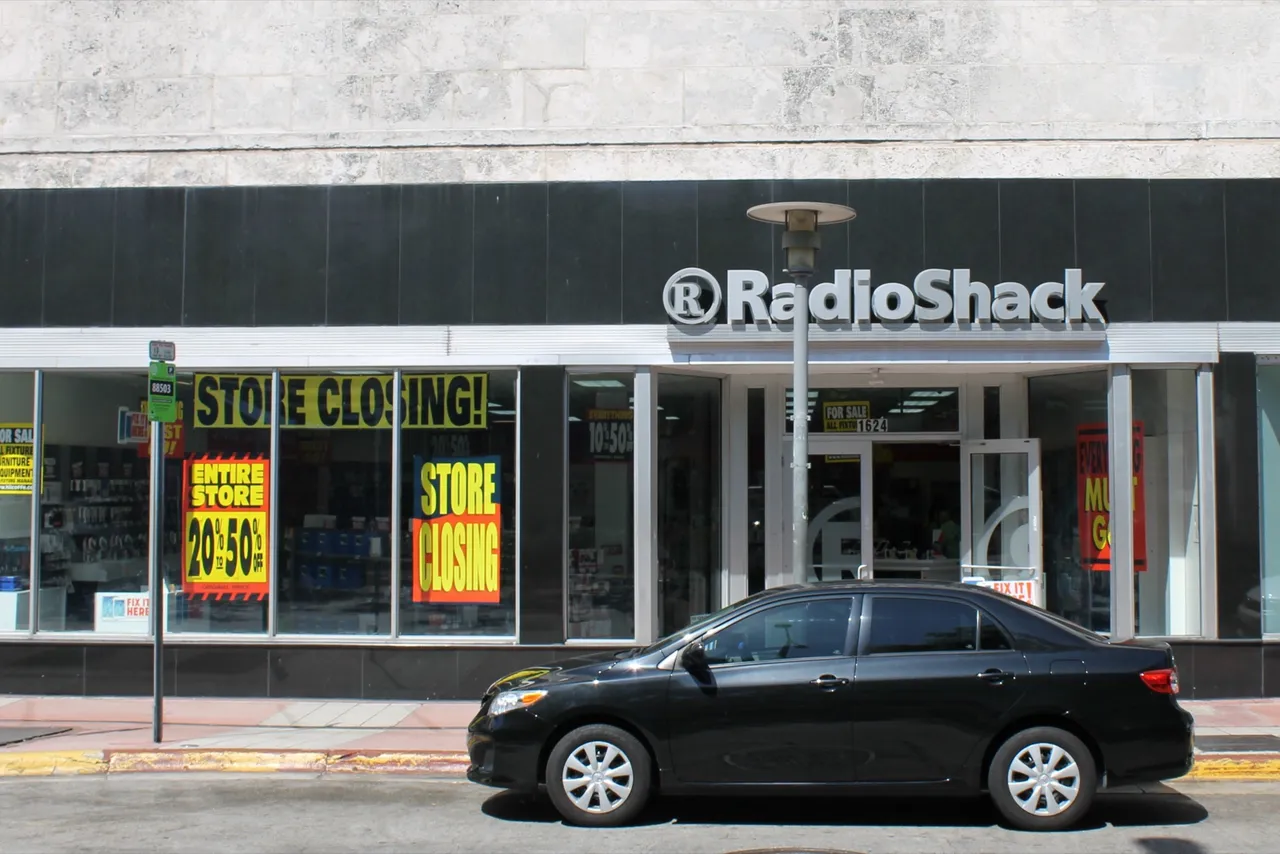
RadioShack went bankrupt in 2015, after ending 2014 with more than 4,100 company stores, and again in 2017. Since 2023 Unicomer Group, a Latin American and Caribbean retailer, has held a majority stake in the name. As of August 2026, RadioShack products are sold through more than 170 former RadioShack stores that signed on as dealers and on Amazon, Walmart, Target and Best Buy.
Where RadioShack is sold now
Kevin Hamann, who runs RadioShack USA, gave the latest count to the trade magazine TWICE in August 2026. More than 170 former RadioShack stores had joined a new Authorized Dealer program, which lets them buy RadioShack-brand goods wholesale again. Besides the big online stores, the goods were on TikTok, and eBay was coming soon. Hamann said the aim was to sell where people already shop instead of rebuilding the old chain.
Why the stores closed
RadioShack went bankrupt twice, in 2015 and 2017, and as we read it, phones run through both. When it filed the first time, its court papers blamed stiff competition from online retailers and “fundamental changes in its mobility business,” meaning phones. In 2013 it lost about $344 million on its operations. When the chain filed again, the chief executive, Dene Rogers, said mobile phone sales had been “surprisingly poor.”
Each time the company pointed at its phone business, and the Sprint shops were meant to fix that but they didn’t. Before the first filing, the stores were redesigned and stocked with big-name headphones and the newest gadgets, but more shoppers didn’t come, the Associated Press reported. After that filing, Sprint shops went into 1,200 of the stores to bring in people shopping for smartphones. By 2017 the AP was describing a store “once known as the place to buy batteries and obscure electronic parts” that was losing customers to Amazon and other online retailers.
A Boston shop named for a hut on a ship
On a ship, the radio shack was the small wooden structure on deck that held the radio gear. A Boston store and mail-order house that served ships’ radio officers took the name. The Deutschmann family started it. There were “four or five brothers,” said Lewis Kornfeld, who later became the company’s president.
Every catalog we read from 1978 on counts from 1921, the year the company gives for its start, and the 1978 one was billed as “Our 57th Year.” Radio Shack’s own 1963 catalog, printed the year Charles Tandy bought the company, tells it differently. It called itself the 40th anniversary catalog and printed “Since 1923” on its order forms. We found no founding document that settles which one to go by.
Kornfeld was hired as the advertising manager in September 1948, and for a while he was the whole department. “I was the photographer, I was the copywriter, I was layout artist, I was the paste up artist, and I also was the media placement officer,” he said in a 2003 interview now held by the Computer History Museum. He even ran the addressograph machine that printed the labels for the catalogs.
Radio Shack was one store then, and it stayed that way into the 1950s, when it added eight more. It sold industrial parts, batteries and ham radio equipment. Upstairs was a hi-fi room called the Audio Comparator, where you could switch from one speaker or amplifier to another until you found what you liked. The mail-order department hardly existed. There were “unopened envelopes all over the place,” and the mailing list was a mess.
Charles Tandy and a store in every town
Out of Fort Worth, Charles Tandy ran what Kornfeld called “the largest leather hobby business probably in the world.” He tried to buy Allied, then Lafayette, and when both turned him down he bought Radio Shack and its nine stores, about April 1963.
Tandy got the Radio Shack people together in their office on Commonwealth Avenue, across the street from Boston University’s headquarters building. He told them he would pick 10 of them, and that in any group of 10 employees, one is a crook. One of the 10 did turn out to be a crook, Kornfeld said, and the manager of the headquarters store at that.
Charles Tandy was bluff, good humored, full of anecdotes, very generous, and he was extremely bright on the subject that he knew best, which was small stores in large numbers with high gross margins and high advertising expenditures.
He dropped the industrial parts and the ham gear and went after ordinary customers with consumer electronics. One of his sayings became the title of a book Kornfeld published in 1983, To Catch a Mouse, Make a Noise Like a Cheese.
Radio Shack’s salespeople knew their products, the 1978 catalog said, because they dealt only in the company’s own brands. “You’ll get no double-talk at Radio Shack.” The same catalog billed Arthur Fiedler as “Radio Shack’s Audio Consultant,” and Kornfeld said he really was on the payroll. Along the bottom of some pages it ran the line “There’s a Radio Shack Near You” and then “Wherever You Are.”
Tandy died on Nov. 4, 1978. The 60th anniversary catalog of 1981 counted 7,700 stores.
The free battery card
The Battery-A-Month card got you one Radio Shack battery a month, free, for a whole year, in D, C, AA or 9-volt, with “no obligation, nothing to buy!” “COME IN FOR YOUR BATTERY-A-MONTH CARD!” said a page of the 1978 catalog, which put a year’s worth at up to $5.88.
The sample card on that page says “FREE BATTERY CLUB” across the top. Below it are blank lines for your name, address, city, state and ZIP code, and one for the sales representative.
In the 1981 catalog the club was still going, now with the General-Purpose Enercell, Radio Shack’s own battery. When it started and when it ended we couldn’t pin down. The 1978 catalog is the earliest one where it turned up in our research.
The 150-in-1 kit and a kid’s toy store
The Science Fair 150-in-1 Electronic Project Kit was “the big one,” the 1978 catalog said. You built radios, a telegraph, a one-way telephone and a wireless mike with “no solder needed,” from parts already mounted in a case and hooked together with spring clips. A 164-page manual explained every project “in nontechnical language,” and an earphone and a code key came with it.
On the same page was a crystal radio kit that “Plays Forever – Without Power,” built with “the same type of circuitry Marconi used” and needing no batteries or AC.
“As a kid, RadioShack was my toy store,” Michael Rosanoff, 33, told TODAY in 2015. He’d drooled over a Golden Arrow RC car there with his dad and got it for Christmas. Warner Crocker, 58, grew up in rural West Virginia, where his father bought ham radio equipment at the store. Once Warner could drive, his dad would hand him a few bucks to go buy 8-inch floppy disks.
The CB years
Citizens band radio was already in the 1963 catalog, where an eight-channel Realistic transceiver came as a kit. Around 1972, Kornfeld said, “it started boiling,” and CB went from about 4% of Radio Shack’s sales to about 20% or 25%, which worried him.
Word got around that everybody had to have a handle. When the oil shock came and people sat in line for hours to buy gas, CBers told each other where the lines were.
“Gone are the old 23s. In are the fabulous 40s,” said the cover of the 1978 catalog, and it told readers, “don’t get caught without your ‘ears’ on.” The whole Realistic CB line had been “re-engineered and restyled,” it said, and Realistic had won over a million new customers the year before.
Then CB went way down, Kornfeld said, and right then Radio Shack came out with a computer. People told him he was smart. “Well, of course, it was serendipitous.”
The TRS-80, or “Trash-80”
The TRS-80 was introduced in August 1977, about the same time Apple and Commodore brought out theirs. The brochure listed a 53-key keyboard, a 12-inch video monitor and a cassette recorder the computer could control. It came “completely wired, tested and U.L. listed, ready to plug in and use.” Around the house you could use it for “personal finance management,” for “storing recipes and, just for fun, to play a variety of computer games.”
With the monitor and the recorder, the system cost $599.95, about $3,335 in today’s money.
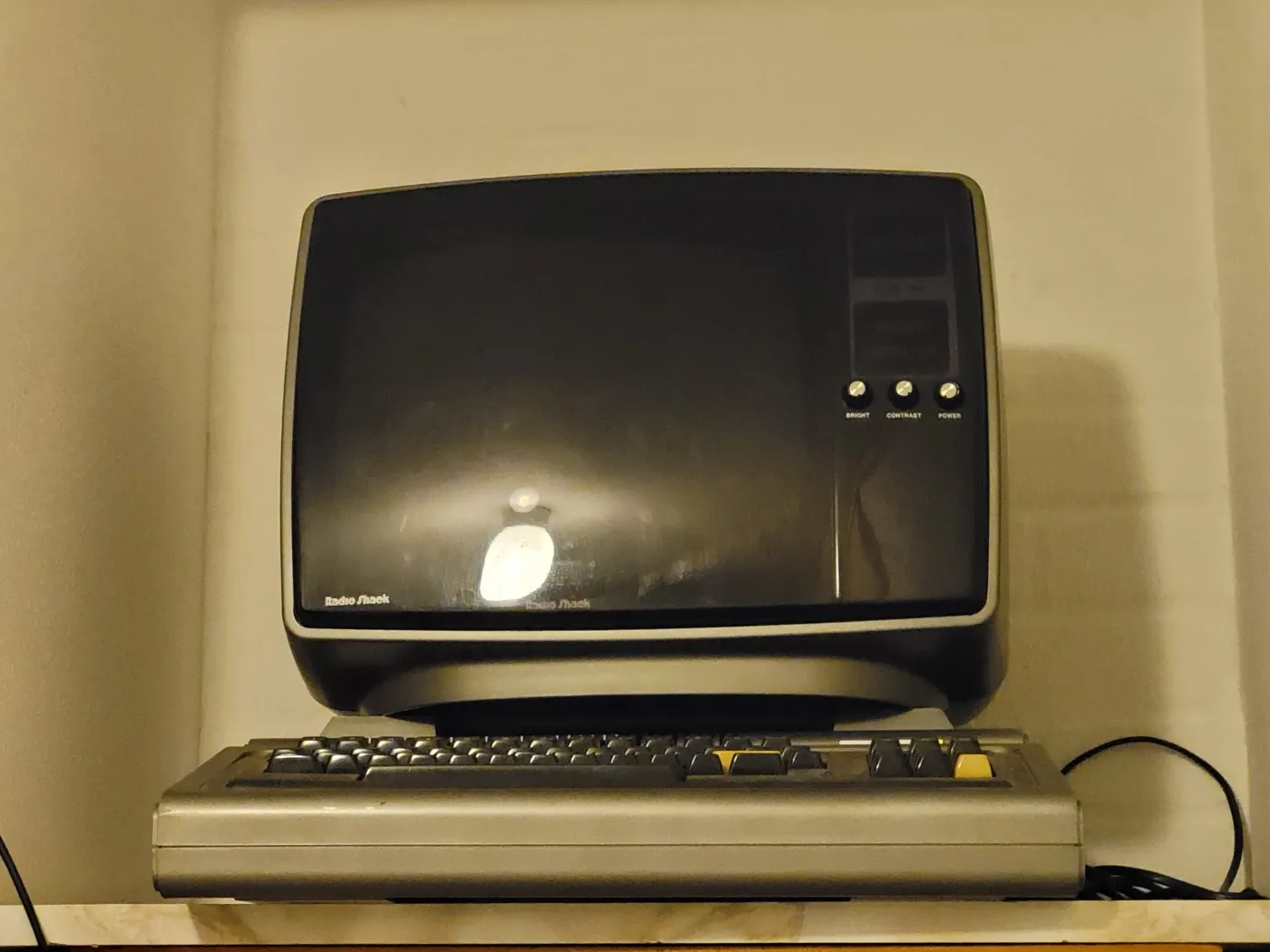
A TRS-80 Model I with its monitor. Photo by Prolete, CC0, via Wikimedia Commons.
Kornfeld called the personal computer “the greatest merchandising scoop of my life.” In January 1980 the magazine 80 Microcomputing wrote that the TRS-80 was “derisively called the Trash-80 by many in the microcomputer industry” and “also adored by tens of thousands of users.” By 1981 the catalog was claiming that the TRS-80 had made Radio Shack the first company to mass-produce computers.
“You’ve got questions”
The 1996 catalog carried a welcome letter signed by the president of Radio Shack, Len Roberts, with the store’s slogan in it: “You’ve got questions. We’ve got answers.” Kornfeld, long retired, thought he could come up with a better one, because he didn’t think the public was “nearly as mystified” as Roberts did. In 2000 Tandy took the store’s name for the whole company, RadioShack Corporation.
RadioShack’s Super Bowl ad on Feb. 2, 2014, made fun of the store itself. “The ’80s called, they want their store back,” a clerk says, and Hulk Hogan, Mary Lou Retton, Dee Snider, the California Raisins, Alf and Chucky carry everything out. “It’s time for a new RadioShack,” the voice-over says. A month later the company said it planned to close up to 1,100 stores it called underperforming.
The 2015 bankruptcy
RadioShack filed for Chapter 11 in Delaware on Feb. 5, 2015. That month, at the store in Thousand Oaks, Calif., Colin Greenidge, a 52-year-old mechanical engineer, was buying things for a project he first called “top secret” and later admitted was a robot.
“The Internet has killed it,” he told TODAY. “Kids today, they just use the Internet. I don’t know if they even know what RadioShack is.” People like him were most of that store’s regulars, said Adam Assil, 24, who worked there and used to come in with his dad.
On April 1, 2015, General Wireless, a company formed by the investment firm Standard General, bought the leases on more than 1,700 of the stores.
How many stores there were
Here is our store count, year by year, from the company’s own catalogs and filings and from what its people told interviewers and reporters. The 1963 figure is the one exception; it’s from the Handbook of Texas. Read it as stores falling from a peak of 7,700 in 1981 to about 4,100 at the end of 2014, then to the 1,700 leases General Wireless bought and the 170 dealers of 2026. The middle rows count slightly different things, as the last column says, so compare each row with its neighbors only loosely.
| When | How many | What it counts |
|---|---|---|
| 1948 | 1 | The Boston store |
| 1963, when Charles Tandy bought it | 9 | Boston-based stores |
| End of 1963 or into 1964 | About 30 | Stores, from memory in a 2003 interview |
| 1978 catalog | 5,200; over 6,000 | U.S. stores; all Radio Shack outlets |
| 1981 catalog | 7,700 | Stores, not split by country or dealer |
| 1996 catalog | 6,600 | Stores and dealers together |
| March 2014 | Over 4,000 after closing up to 1,100 | U.S. stores it planned to keep, 900+ dealer franchises included |
| Dec. 31, 2014 | More than 4,100 | Company stores in the U.S., with 21,000+ employees |
| April 2015 | More than 1,700 | Store leases bought by General Wireless |
| March 2017 | 200 closing, 1,300 under review | General Wireless stores |
| August 2026 | 170+ | Former stores now authorized dealers |
What happened to all those names and addresses
In 2015 RadioShack’s customer files went up for sale along with the name. A Bloomberg report said the sale listing offered 65 million customer name and address files and more than 13 million email addresses.
The company’s privacy policy had said, “We will not sell or rent your personally identifiable information to anyone at any time.” Texas and 37 other states objected through their attorneys general.
The buyer was another Standard General company. Under the deal the court approved that June, it got only the email addresses customers had given in the past two years and some sales records. It couldn’t sell or share any of it. Phone numbers and birthdates didn’t go along, and most of the rest was to be destroyed.
The second bankruptcy and the owners since
General Wireless filed for bankruptcy on March 8, 2017, and said it was closing 200 stores and would weigh its options for the other 1,300. Sprint said it would turn “several hundred” of those into Sprint-only stores.
General Wireless Operations still owned the brand when it came out of bankruptcy, about 2018, and sold it to Retail Ecommerce Ventures in 2020. In May 2023 Unicomer Group took a majority stake. Unicomer runs hundreds of RadioShack stores in Central and South America and the Caribbean. Its first RadioShack franchise, in 1998, was in El Salvador.
Hamann told TWICE that some of the strongest sellers now are turntables and radios with a vintage look.
Questions people ask
What year did RadioShack start?
The company has dated itself to 1921 since at least 1977. Its own 1963 catalog said “Since 1923,” though, and no founding record we found settles which year is right.
Who owns RadioShack now?
Unicomer Group, a company in retail and financial services that operates throughout Latin America and the Caribbean, took a majority stake in the brand in May 2023, with rights in about 70 countries, the U.S. among them. After the 2015 bankruptcy the name went to a Standard General company, and Retail Ecommerce Ventures bought it in 2020.
What does TRS-80 stand for?
Tandy Radio Shack, plus 80 for the Z-80 microprocessor inside it, according to the TRS-80 historian Matthew Reed. Radio Shack’s 1977 brochure lists the Z-80 among the computer’s parts.
What brands did Radio Shack sell?
Mostly its own. Realistic was the name on its CB radios and hi-fi, Enercell on its batteries and Science Fair on its electronics kits. The 1978 catalog said its salespeople dealt only in Radio Shack’s own brands.
Written by Wance Payton, Oct. 19, 2026
25 sourcesWhere these facts come from
- Lewis Kornfeld, interview by J. Mitchell Johnson, Fort Worth, Nov. 24, 2003, Computer History Museum, catalog 102739936 (transcript)
- Radio Shack 1978 Catalog No. 289, "Our 57th Year," cover and pages 3, 105, 138 (scans)
- Radio Shack, "TRS-80 Microcomputer System" brochure, 1977, Internet Archive
- Radio Shack 1981 Catalog No. 328 (60th Anniversary Catalog), pages 2 and 142, Internet Archive
- Radio Shack Corporation Mail Order Catalog No. 124, "40th Anniversary," 1963, Internet Archive
- Radio Shack 1996 Catalog, World Radio History
- Wayne Green, "80 Remarks," 80 Microcomputing, January 1980, Internet Archive
- Matthew Reed, "The Introduction of the TRS-80 (Part 2)," TRS-80.org
- Diana J. Kleiner, "Tandy, Charles David," Handbook of Texas Online, Texas State Historical Association
- RadioShack Corporation, "RadioShack Reports Financial Results for Fourth Quarter 2013," press release, March 4, 2014, Exhibit 99.1 to Form 8-K
- Joint Disclosure Statement of RS Legacy Corporation, U.S. Bankruptcy Court, District of Delaware, Case No. 15-10197, Exhibit 2.2 to Form 8-K, Oct. 7, 2015
- RadioShack Corporation, Form 8-K, Feb. 5, 2015
- Grant Morgan, "Exclusive Interview: Kevin Hamann, Managing Director Of RadioShack USA," TWICE, Aug. 26, 2026
- Tom Clark, "Who Is RadioShack Owned By And How Many Stores Are Left?," SlashGear, Sept. 5, 2026
- Daphne Howland, "RadioShack under new ownership again," Retail Dive, Aug. 17, 2023
- Ben Unglesbee, "RadioShack brand acquired by new owner of Pier 1, Modell's IP," Retail Dive, Nov. 19, 2020
- Keith Wagstaff, "Last days of RadioShack: Fans remember an institution," TODAY, Feb. 9, 2015
- Eyder Peralta, "RadioShack, The Electronics Chain, Files For Bankruptcy," NPR, Feb. 5, 2015
- Sam Schulz, "Super Bowl XLVIII Commercials: Families, Beasts and Sitcoms," NBC Los Angeles, Feb. 2, 2014
- Bloomberg, "RadioShack's bankruptcy could give your customer data to the highest bidder," March 2015, via BlackPressUSA
- CBS New York, "Report: Radio Shack To Sell Customers' Personal Information In Bankruptcy Sale," March 25, 2015
- NewsChannel 5 Nashville, "Tennessee attorney general wants Radio Shack info kept private," 2015
- Associated Press, "RadioShack files for second bankruptcy in 2 years," March 9, 2017, via KSL.com
- CNBC, "RadioShack files for bankruptcy for second time in 2 years," March 9, 2017
- Rebecca Hersher, "RadioShack files for bankruptcy -- again," NPR, March 9, 2017, via MPR News