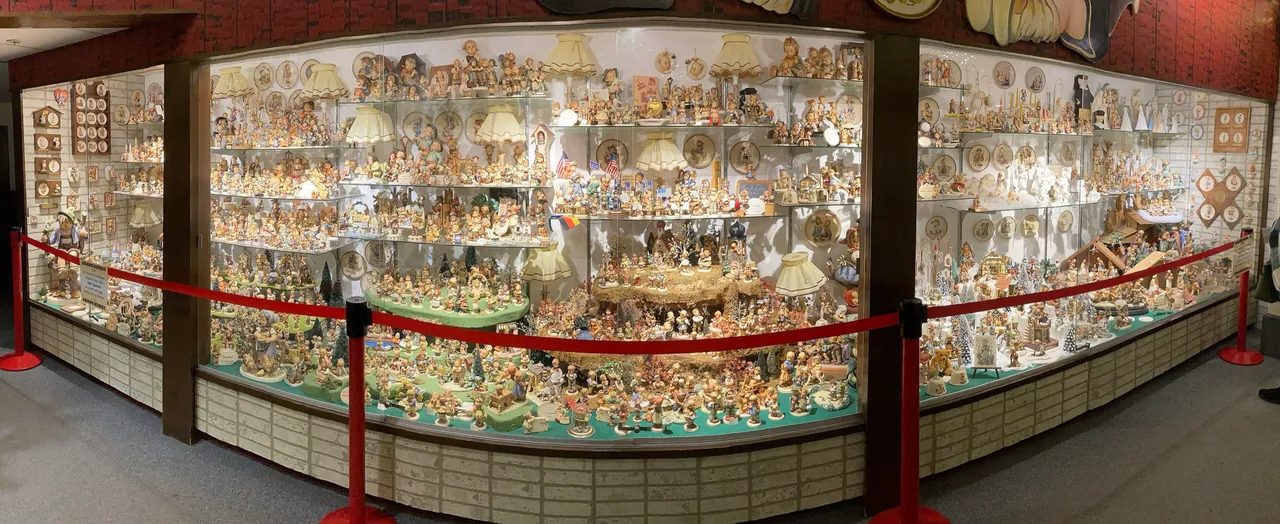
Most single Hummel figurines sell for under $50: 131 sold on eBay from June to mid-October 2026 had a $22.95 median. At two U.S. auction houses, almost all online, 50 lots sold since July 2025 had a $47.50 median, most with two or more figures. Large pieces, roughly 8 inches and up, can bring a few hundred dollars, while most small single figures sold for $5 to $25 in 2023–2026 auction results.
Figures bought new in the 1970s or ’90s sell for a fraction of what they listed for. On July 30, 2026, Everything But The House, an online estate-sale company, sold a School Girl for $5 and a Girl with Nosegay for $6.
I counted two sets of recent sales. One is 50 Hummel figurine lots sold at auction, nearly all of them at Everything But The House. The other is the first page of results for completed U.S. sales on eBay, which held 131 single figures once I left out deals made by private offer.
| Sales I counted | How many | Dates | Median price | Under $50 | $100 or more | Best price |
|---|---|---|---|---|---|---|
| Auction lots | 50 | July 2025 to Oct. 2026 | $47.50 a lot | 27 | 7 | $305 |
| eBay, single figures | 131 | June to mid-Oct. 2026 | $22.95 | 104 | 13 | $350 |
Most of the auction lots held two or more figures so the price per figure ran below the lot median. The best lot was a group led by a “Letter to Santa Claus,” sold in September 2026, and the best price on eBay was paid for a large School Girls.
What they cost new, and what they bring now
To see how far the prices fell, I went through four U.S. retail price lists. Schmid Brothers of Boston, a U.S. distributor of Goebel’s in the 1950s, bound the earliest into its 1955 Hummel booklet. The others are a list dated Jan. 1, 1965, Goebel’s 1975 suggested retail list and the U.S. list Goebel put on its website, effective Jan. 1, 1997.
The 1975 copy I read carries the stamp of The Windsor Shoppe, a card and gift store on Washington Avenue in North Haven, Conn. On the 1965 list a footnote tells dealers that most figures were “offered in assortments only.”
Here’s what those lists asked for some of the best-known figures, with today’s money in parentheses, next to a dated auction result for the same model:
| Figurine | 1955 | 1965 | 1975 | 1997 | Sold at auction |
|---|---|---|---|---|---|
| Merry Wanderer, about 6” | $6.50 ($82) | $8.50 ($91) | $45 ($282) | $310 ($651) | $11, Berner’s Auction Gallery, March 2023 |
| Merry Wanderer, about 4¾” | — | — | $28 ($175) | $225 ($472) | $7 to $14, Berner’s Auction Gallery, 2023 |
| Umbrella Boy, 8” | $40 ($503) | $50 ($535) | $410 ($2,567) | $1,600 ($3,359) | $280, Manor Auctions, June 2021 |
| Apple Tree Boy, about 10” | — | — | $250 ($1,565) | $1,350 ($2,834) | $225 with an Apple Tree Girl and one box, Whites Auctions, Dec. 2023 |
| Stormy Weather, small (about 4½”) | — | — | — | $330 ($693) | $25, Matthew Bullock Auctioneers, Jan. 2026 |
| Adventure Bound | — | — | $800 ($5,009) | $3,980 ($8,354) | $360, Philip Weiss Auctions, July 2022 |
| School Boys, large (about 10”) | $84 ($1,057) | $100 ($1,069) | $650 ($4,070) | — | $180, Whites Auctions, Dec. 2021 |
Today’s money is September 2026 dollars. Sizes differ a little from list to list, so I matched the closest size or model number. The auction prices are hammer prices, meaning the winning bid. The buyer also paid the auction house a fee on top, called the buyer’s premium, and that isn’t included.
The $280 Umbrella Boy in the table had no box when Manor Auctions sold it in June 2021, and the house graded it very fine. New, that 8-inch figure listed at $40 in 1955, about $503 in today’s money. Goebel’s 1997 list had it at $1,600, more in real terms than even the 1975 price.
Which Hummels still bring real money
Among the single figures and pairs I found sold at auction since 2021, every one that brought more than $100 was a large piece. Where the listing gave a size, nearly all were 8 inches or more, such as the 8-inch Umbrella Boy and the 10½-inch Apple Tree Boy and Girl. On eBay, four of the five best prices went to figures the sellers called large or measured at 8 inches or taller.
At the same Manor Auctions sale as the Umbrella Boy, the 8-inch Umbrella Girl brought $180. Whites Auctions described its School Boys, the one in the table, as the largest size, retired in 1982, with no cracks, chips or repairs.
Adventure Bound, the priciest piece in the table on both the 1975 and 1997 lists, is large in another way. It’s a group of seven children, 7¼ by 8 inches on the 1975 list. When Philip Weiss Auctions sold one for $360 in July 2022, the house called it large and said it appeared to be “in very nice condition.”
The biggest I found was a 32-inch “jumbo” Apple Tree Boy from the estate of Norma Szaro of Swampscott, Mass., which Kaminski Auctions sold for $800 in January 2021.
Does a crown or full bee mark make it worth more?
Lion & Unicorn’s value guide, the first result when I searched Google, says crown-mark pieces “can be worth 5 to 20 times more than the same model produced under a later mark.”
At the one sale where I found several early-mark pieces sold side by side it didn’t work out that way. On Oct. 21, 2023, Homestead Auctions sold a crown-mark Little Cellist and a crown-mark Sensitive Hunter for $25 each, and a crown-mark Feeding Time brought $60. Full bee pieces at the same sale brought $5 to $25. For scale, Schmid’s 1955 list had Little Cellist at $9 and Sensitive Hunter at $6.50, about $113 and $82 after inflation.
That’s one sale on one day, but it does suggest that an early mark on a small, common figure won’t lift the price far by itself. Berner’s Auction Gallery sold five Merry Wanderers in 2023 for $7 to $14 each, and at least two of them carried the later “Goebel W. Germany” mark.
Homestead’s Happy Pastime, marked as made in the U.S. occupied zone, came with a box the seller called rare, and it brought $25. And the 8-inch Umbrella Boy brought its $280 at Manor Auctions without one.
How to tell how old your Hummel is
Turn it over. A genuine M.I. Hummel figure carries Sister Hummel’s signature cut into the base and a Goebel stamp on the underside. Only figures without a base, or without room for the signature, go without it, and it’s the stamp underneath that tells you roughly when a piece was made.
The stamp won’t give you a year, it gives you a span of years. Goebel changed it many times and the marks overlapped, so the sources don’t agree on the exact dates.
The table puts Goebel’s own trademark chart, as it stood on the company’s website in 2002, beside a 2021 Antique Trader guide by Heidi Ann Von Recklinghausen, author of The Official M.I. Hummel Price Guide. Match the stamp on yours to a row. Where the two columns differ, your piece could come from anywhere in either span.
The TMK numbers in the table are collectors’ shorthand from that guide. You don’t need them to date a piece, but auction listings use them, so “TMK-5” on a listing means the Last Bee.
| Mark (collectors’ name) | Goebel’s chart, 2002 | Antique Trader, 2021 |
|---|---|---|
| Crown (TMK-1) | 1935–1949 | 1934–1950 |
| Full Bee (TMK-2), a large bee flying in a V | 1950–1955 | 1940–1959 |
| Smaller bees, Stylized Bee (TMK-3) and Three Line (TMK-4) | several versions, 1956–1972 | 1958–1972 and 1964–1972 |
| Last Bee (TMK-5) | 1972–1979 | 1972–1979 |
| Missing Bee (TMK-6) | 1979–1990 | 1979–1991 |
| Hummel Mark (TMK-7), made for German reunification, “Germany” without “West” | from 1991 | 1991–1999 |
| Millennium Bee (TMK-8) | not on the 2002 chart | 2000–2008 |
| Manufaktur Rödental (TMK-9) | not on the 2002 chart | 2009 to now |
The guide’s own text puts the bee in the V at 1950, which agrees with Goebel, and it calls the early dates “probably accurate to within five years or so.” It also dates two other markings that give a narrower span. Pieces exported from 1946 through 1948 were marked as made in the U.S. occupied zone. From 1990 Goebel stamped “First Issue” on new pieces, and from 1991 “Final Issue” on pieces in their last year before retirement.
Hummels also carry a model number, such as Hum 7/0 for a Merry Wanderer, and the part after the slash gives the size. On the 1975 list, Merry Wanderer 7/0 is the standard 6¼-inch figure and 7/II is 9½ inches.
Why Hummels are so cheap now
Hummels go back to Berta Hummel, born in 1909 in Massing, Bavaria, who entered the Franciscan convent at Siessen in 1931 and took the veil in 1934 as Sister Maria Innocentia. That same year Franz Goebel, looking for something new for his company, saw her drawings of country children on art cards. Goebel showed the first figures at the Leipzig Spring Fair in March 1935. During the war fuel was scarce, and Goebel’s history says she had to work in a cold, unheated room. She died in 1946, at 37, of tuberculosis.
The accounts differ on when American soldiers took to them. Goebel’s history says it was after the war, when the soldiers occupying Germany were looking for keepsakes to mail home. Terry Kovel, quoted by WalletPop in 2010, put it during the war, with soldiers buying them in Europe for wives, girlfriends and parents, who “thought they were cute.”
List prices climbed fast after the mid-‘60s, and the 8-inch Umbrella Boy went from $50 in 1965 to $410 in 1975. Goebel started a collectors’ club in 1977, and Kovel said many dealers sold Hummels for their “investment merits.”
“Back in the 70s and 80s they started all this limited editions stuff: they had plates and bells, and you name it. They thought they could fool the public,” Kovel said. Goebel had started its annual plates in 1971, and the 1975 plate alone listed at $50, about $313 now. In 2010 WalletPop reported a lot of nine Hummel plates dating from the 1970s to the early 1990s selling for less than $15 a plate. The Associated Press reported in 2009 that Goebel had pushed production up, at times to hundreds of thousands of figures a year.
In June 2008 The Local, an English-language news site in Germany, reported that demand had dropped to a third of what Goebel expected. Some 230 of the factory’s 340 workers were to lose their jobs. That fall the M.I. Hummel Club told collectors that production in Rödental “will end on October 31, 2008. Sales will continue as long as supplies last.”
“If we have a Hummel whose book value is $325, they are now bringing about $50, sometimes less,” estate liquidator Julie Hall told WalletPop in 2010. Kovel, in the same piece, said “a lot of young people kind of hate the things and think they’re saccharine.”
WalletPop’s own writer, Zac Bissonnette, added that every day Hummel enthusiasts die and their collections get “dumped onto an already saturated market.”
Of the 50 auction lots I counted, 48 were sold by Everything But The House, and most were group lots. Most of its items start at $1, the company says. The listings don’t say which homes the figures came out of, and the company also sells for dealers and collectors.
Are Hummels still made?
Hummels are still made in Rödental, though no longer by Goebel. A new firm bought the factory equipment and rights in early 2009 and started with a staff of 30; Goebel’s whole factory, which also made other products, had 340 the year before. Another group of owners took over on Nov. 1, 2013, when the company had 40 workers.
Today’s maker, Hummel Manufaktur GmbH, sells new figures from Rödental, and Hummel Gifts, which sells them in the U.S., lists a 2026 special edition of Smiling Through at $549. In 2011 the club said the Convent of Siessen and the Hummel family still approved every M.I. Hummel piece before production began.
Questions people ask
Will the Hummel company tell me what my figurines are worth?
Don’t count on it. In 2011 the M.I. Hummel Club’s questions-and-answers page said the company does not appraise its products, and that what a piece really sells for comes down to what a buyer will pay and a seller will take.
Are Hummel figurines porcelain?
Goebel’s own history says they are earthenware, a material the company says it pioneered in the 1920s. Many auction listings call them porcelain anyway.
What’s the difference between M.I. Hummel and Berta Hummel figurines?
Berta Hummel pieces were a separate line, sculpted by Goebel’s artists, approved by the Convent of Siessen and made in the Far East under Goebel’s supervision. The M.I. Hummel Club called them authentic Hummel products in 2011. That line ended in 2007.
Is the hole in the bottom, or fine cracks in the glaze, a flaw?
Both are normal. The M.I. Hummel Club said every M.I. Hummel figurine has an air hole, either under the base or in the back, and that the tiny cracks in the glaze called crazing are a natural condition of glazed ceramics.
How should I clean a Hummel figurine?
The M.I. Hummel Club’s advice was to cover the air hole first, then go over the figure with a clean shaving or makeup brush dipped in tepid water and a mild soap such as baby shampoo.
Written by Wance Payton, Oct. 14, 2026
24 sourcesWhere these facts come from
- Goebel / M.I. Hummel, "Marks of Authenticity" and trademark chart, mihummel.com, 2002 (Internet Archive)
- Goebel / M.I. Hummel, "Heritage: Goebel," mihummel.com, c. 1996–2002 (Internet Archive)
- Schmid Brothers, Inc., The Original "Hummel" Figures in Story and Picture, with retail price list, Boston, 1955
- Retail Price List of Genuine "Hummel" Figurines, Jan. 1, 1965
- Hummelwerk, 1975 Suggested Retail Price List, Authentic "M.I. Hummel" Figurines by Goebel, Elmsford, N.Y.
- Goebel / M.I. Hummel, Price List Effective Jan 1, 1997 in the United States, mihummel.com (Internet Archive)
- Heidi Ann Von Recklinghausen, "How To Identify Hummel Trademarks," Antique Trader, May 25, 2021
- Zac Bissonnette, "Kitsch and capitalism: The rise and fall of Hummel figurines," WalletPop, Jan. 26, 2010 (Internet Archive)
- M.I. Hummel Club, "Ask Goebel" questions and answers, mihummelclub.com, 2011 (Internet Archive)
- Goebel of North America, "Latest News from the M.I. Hummel Club," Oct. 2008, reprinted by News-Antique.com (Internet Archive)
- The Local, "Famed Hummel figurines get the axe," June 18, 2008
- The Local, "New firm picks up shards of Hummel figurine production," Feb. 5, 2009
- The Associated Press, "Hummels Regain Fragile Foothold on Life," The New York Times, Sept. 8, 2009
- inFranken.de, "Maja Manufacture produziert jetzt die Hummelfiguren," Oct. 31, 2013 (German)
- Gerlinde Runzler, "Hummel, Maria Innocentia," Neue Deutsche Biographie 10, 1974 (German)
- Hummel Manufaktur GmbH, official online shop, Rödental
- Hummel Gifts, "Figurines," October 2026
- Lion & Unicorn, "Hummel Figurines Value Guide" (read Oct. 17, 2026)
- Barnebys, realized prices for Hummel figurines at U.S. auctions, 2021–2026
- Everything But The House, "About Us," ebth.com, Oct. 2026 (Internet Archive)
- eBay, completed sales of Goebel Hummel figurines, June–October 2026 (read Oct. 17, 2026)
- Kaminski Auctions, "Rare Jumbo Hummel Apple Tree Boy," Jan. 16, 2021 (Barnebys)
- Philip Weiss Auctions, "Goebel Hummel Figure 347 'Adventure Bound'," July 27, 2022 (Barnebys)
- Manor Auctions, "Large Goebel Hummel Umbrella Boy 8"," June 26, 2021 (Barnebys)